Societal resilience cannot be built by governments alone. It has to be built by institutions, businesses, civil society and citizens together and it has to hold up under the weight of today’s overlapping crises rather than simply survive them one at a time.
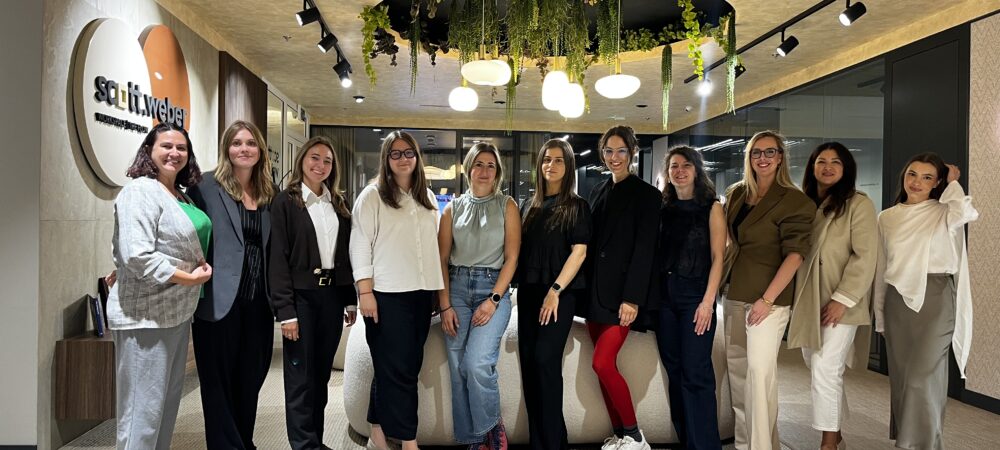
The seventh edition of the CEE Her Workshop took place from September 911, 2026, in Prague, bringing together a cohort of emerging women leaders from across Central and Eastern Europe. This year also marked a structural first for the initiative: alongside the established policy working sessions, GLOBSEC launched a formal Mentorship Programme CEE Her Leadership Academy, pairing participants with senior experts so that the relationships and the exchange of ideas continue beyond the workshop itself.
We opened informally on Wednesday evening, September 9, with a Welcome Dinner, where the cohort met for the first time and began discussing some of the questions that would shape the following two days.
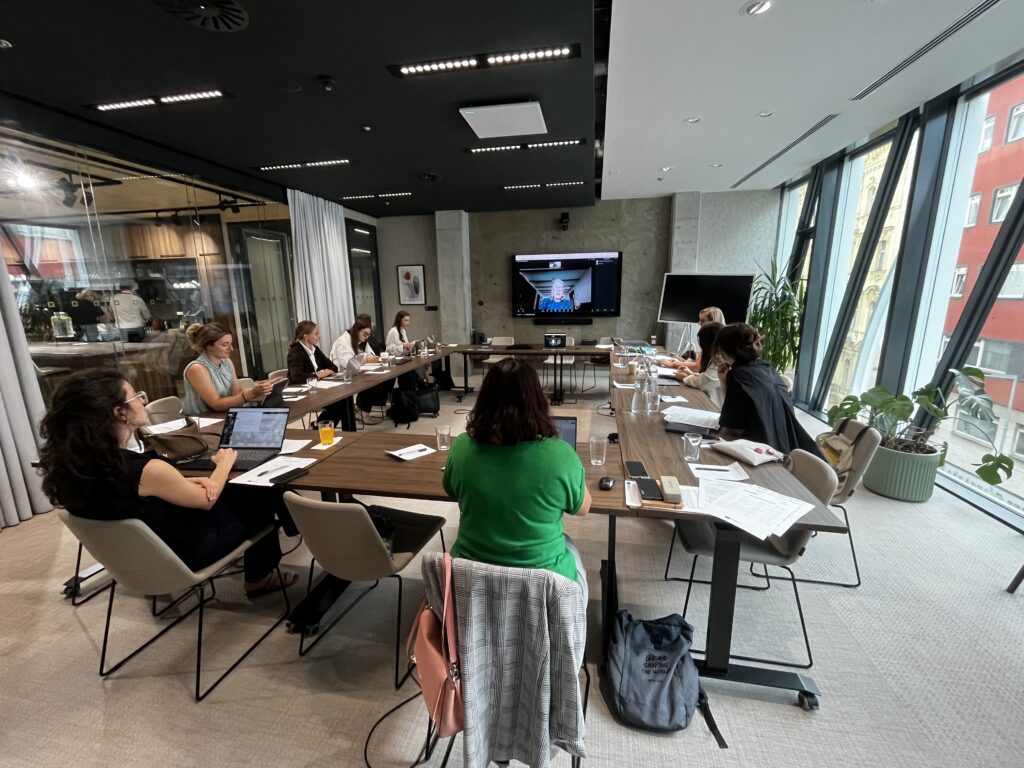
Day one began on Thursday morning, September 10, with a Collaborative Workshop exploring the intersection of technology, governance and societal resilience. The session was opened by Chloé Pahud, Founder and CEO of Civocracy, who is also one of this year’s CEE Her mentors alongside Lenka Hlinková, Co-Founder and Chief Innovations Officer of Female Algorithm. Chloé introduced some of the central questions for the workshop, including how digital participation tools can strengthen democratic engagement while ensuring transparency, digital literacy and meaningful influence on decision making.
Working from challenges drawn from their own professional and personal experiences, participants examined the role technology plays, identified governance gaps and proposed both immediate and longer term solutions. Discussions focused on four areas: the information space and data sovereignty; democratic participation and institutional trust; AI adoption and inequalities in the economy and future of work; and Europe’s infrastructure and cybersecurity resilience.
By the afternoon, these discussions had converged around nine recurring problems, ranging from financing and enforcement gaps to siloed strategies and weak inclusion. Four recommendations repeatedly emerged:
- Give private companies a structured role in public resilience, rather than relying on ad hoc goodwill.
- Formally fund and integrate civil society organisations into crisis frameworks, recognising their role as consistent first responders.
- Manage reliance on non European technology through compliance and continuity planning, rather than pursuing exclusion outright.
- Treat digital skills leadership as a long term cultural investment, rather than a one off training exercise.
Following the workshop, we welcomed Katarína Kakalíková from the Mastercard Center for Inclusive Growth for a conversation with our mentees. She reflected on her professional journey across international organisations and explained how her career choices have been guided by personal motivation, continuous learning and core values rather than a rigid longterm plan. Describing her role as that of a “bridge builder,” she emphasised the importance of dialogue and talent exchange between the public and private sectors. She also highlighted the importance of adaptability in the face of technological change, including the potential of AI to streamline administrative tasks and create more space for human connection and collaboration.
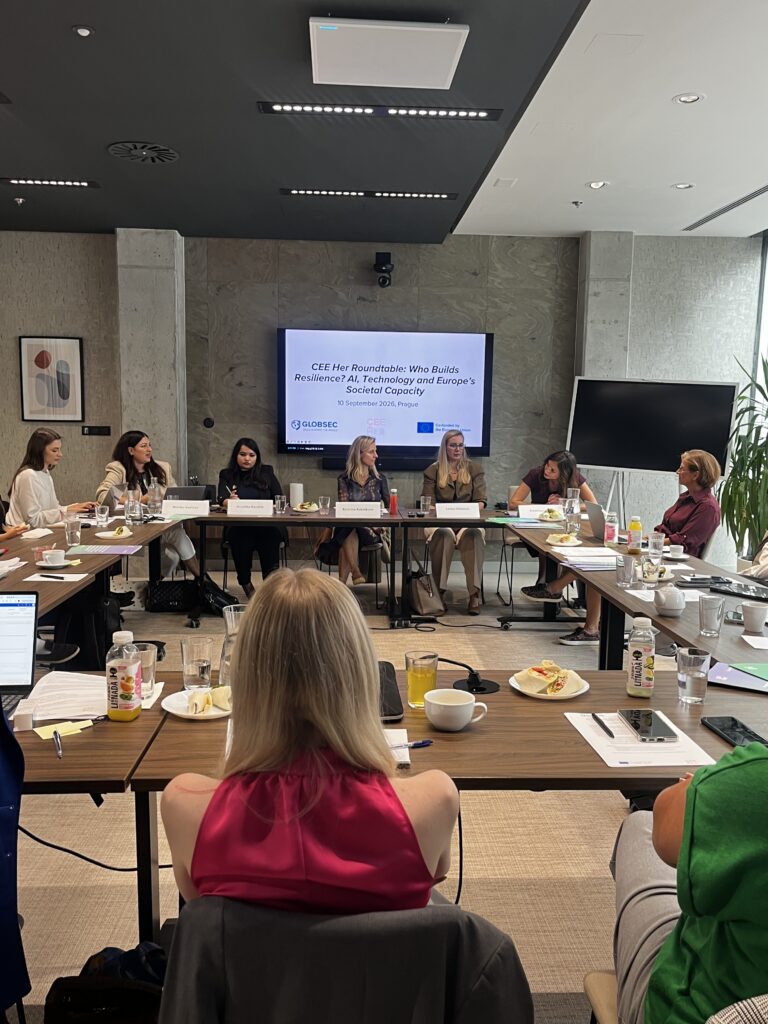
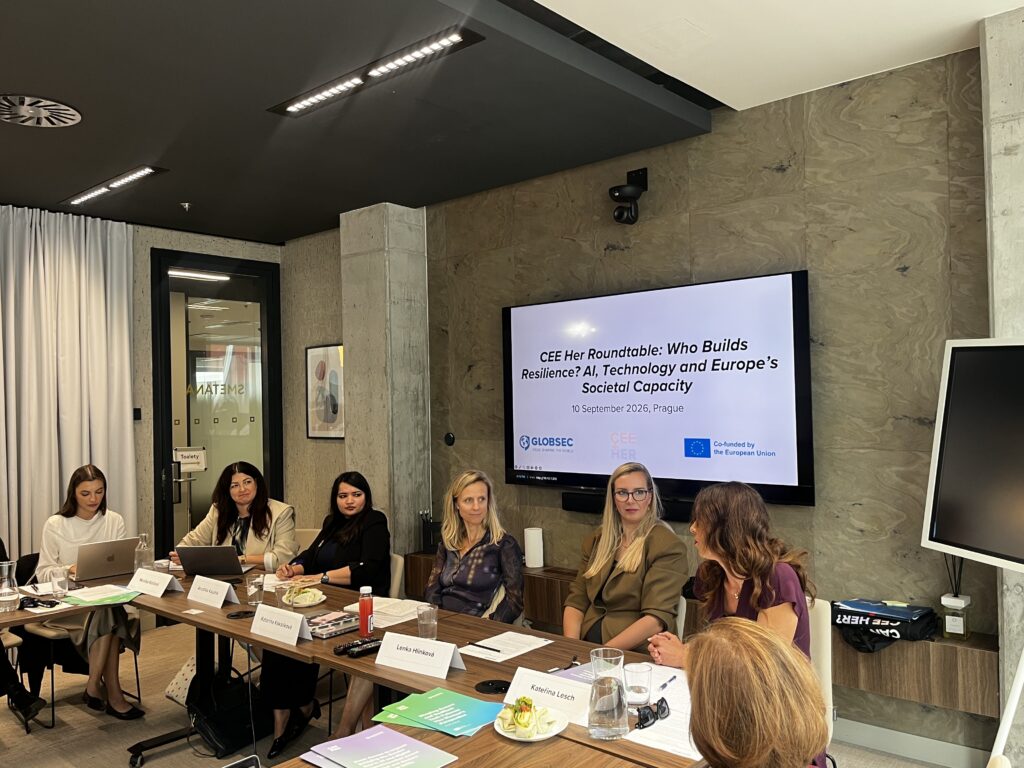
The day closed with the CEE Her Roundtable, “Who Builds Resilience? AI, Technology and Europe’s Societal Capacity,” moderated by Monika Kočiová, public-private dialogue and business environment expert, Kateřina Lesh (Dr. Max Group) argued that AI works best as an enabling layer within a wider business strategy rather than as a standalone initiative. Katarína Kakalíková (Mastercard Center for Inclusive Growth) highlighted the barriers preventing many European microbusinesses from adopting AI, particularly limited time and access to guidance. She also described how Mastercard’s realtime transaction data has supported crisis response, cybersecurity for civil society and refugee resettlement.
Lenka Hlinková, (Female Algorithm), noted that AI adoption still lags sharply outside large corporations, with NGOs further behind, and argued that as AI commoditises technical skills, human judgement and adaptability become increasingly important. Anushka Kaushik, GLOBSEC’s Cyber Lead, cited Unit 42 research describing AI today primarily as a force multiplier for existing attackers rather than a fundamentally new threat, while also noting the limited treatment of cybersecurity within the EU AI Act. The panel closed with a shared call to strengthen sovereign regional data infrastructure and a reminder that AI adoption alone does not amount to societal resilience.
Participants also had the pleasure of welcoming Petra Lovčinská, AI Business Implementation Lead at Raiffeisenbank, for a dinner and informal conversation with the mentees about professional journeys and experiences, as well as their visions for the future.
Day two, on Friday, September 11, tested the same thinking against seven live policy challenges. On strategic communication, participants explored how AI could help sustain official messaging in contexts where anti pluralistic regimes dismantle communication bodies, while recognising that the same tools can also be turned against the people they are intended to protect.
The remaining policy challenges followed a similar pattern: real capacity gaps met with cautious, targeted solutions rather than sweeping technological fixes. On electoral integrity, speed emerged as a central problem, with viral disinformation often outpacing institutional responses. On crisis foresight, participants explored how AI driven early warning systems could help resource constrained governments identify emerging risks and mobilise resources before disaster strikes, rather than responding only after the fact.
Across the three days, one idea kept returning: resilience is not something that can be built once and then left in place. It depends on people, institutions and partnerships that can adapt as new challenges emerge.
Across workshops, policy discussions, mentoring sessions, networking and informal conversations, participants explored not only how technology can strengthen societies, but also where technology alone falls short. The discussions repeatedly returned to the importance of governance, human judgement, institutional capacity, cross- sector cooperation and adaptability.
Just as importantly, the CEE Her Workshop demonstrated the value of creating a safe space where emerging women leaders can exchange experiences, challenge assumptions, build relationships and develop ideas together.
What became clear throughout the three days was that technology is only one part of the resilience equation. The harder task is building the skills, trust, institutions and relationships that allow societies to use it well especially when a crisis hits.