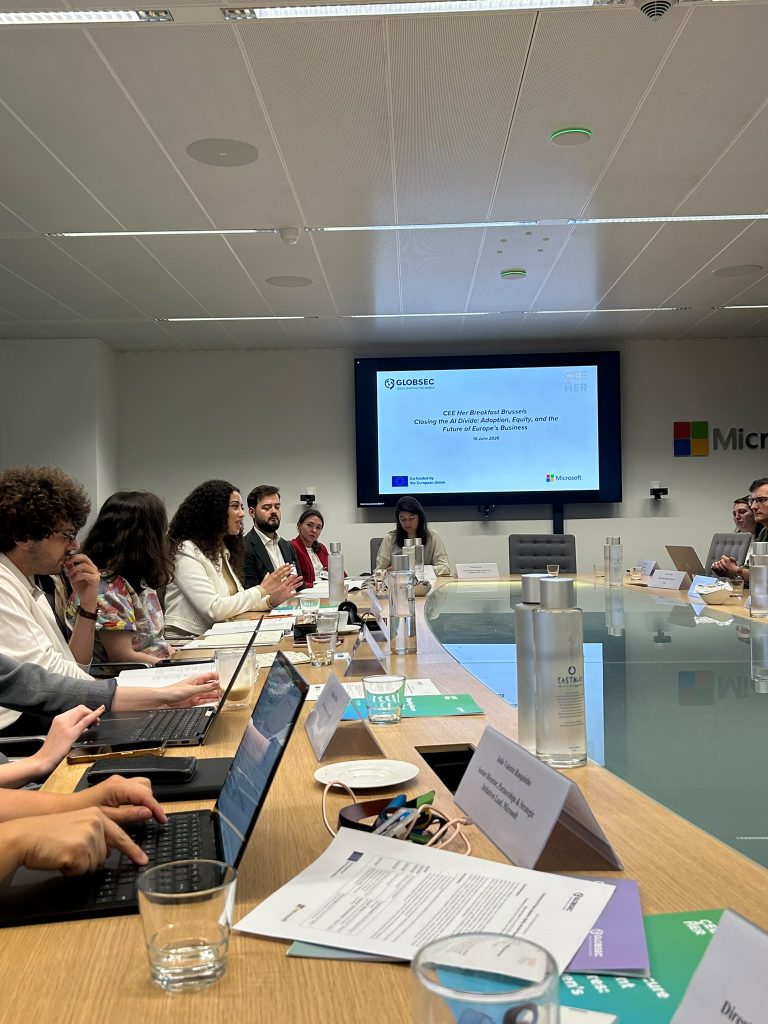
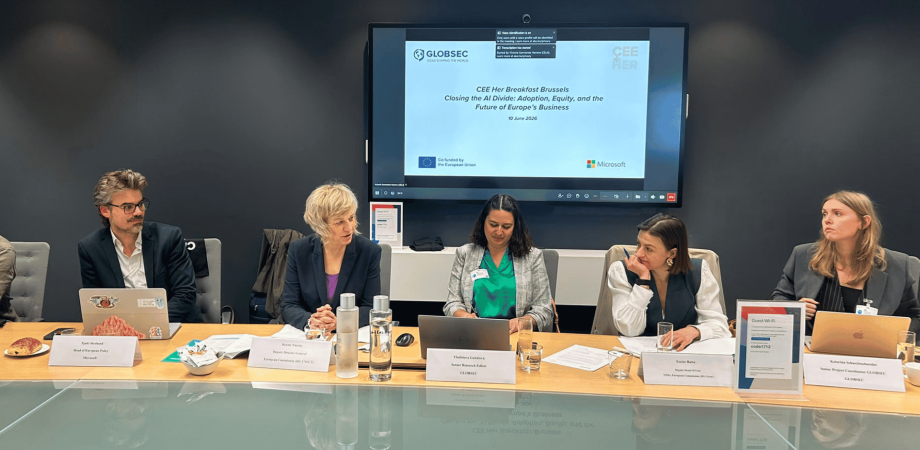
On 10 June 2026, GLOBSEC organised a CEE Her Breakfast event titled Closing the AI Divide: Adoption, Equity, and the Future of Europe’s Business, co-hosted with Microsoft at their Brussels Centre. The event brought together representatives of EU institutions, the startup ecosystem, civil society, and research, and was moderated by Vladislava Gubalova, Lead of the GLOBSEC CEE Her Initiative. GLOBSEC also presented its report From Access to Impact: Bridging the Gender Gap in AI and Digital Transformation across Central and Eastern European SMEs. Speakers included Tjade Stroband (Head of European Policy, Microsoft), Renate Nikolay (Deputy Director General, DG CNECT, European Commission), Katarina Schachtschneider (Junior Research Fellow, GLOBSEC), Eszter Batta (Deputy Head of Unit for SMEs, DG GROW, European Commission), Serena Borbotti-Frison (Director General, Allied for Startups), Sana Afouaiz (Founder and Director, Womenpreneur Initiative), and Federico Plantera (Researcher, Centre for European Policy Studies, CEPS).
AI Adoption and Inclusion Context: AI adoption is accelerating globally, with a 1.68 percentage point increase in Q1 2026 across 147 assessed countries, and CEE countries are performing at or above this average, with Slovakia ranked 38th. Inclusion – particularly women’s participation was identified as critical to avoiding systemic bias and ensuring broader societal impact, with the outcome emphasising that inclusion must be positioned as central to AI strategy rather than treated as a parallel concern.
European Competitiveness and Policy Direction: Europe faces a technological race requiring a careful balance between innovation and regulation. SME AI uptake stands at around 20%, with comparable gender disparities in AI roles; the discussion pointed to the need to strengthen skills policies and integrate a gender dimension explicitly into the tech sovereignty agenda.
Gender Gap Economic Impact: In her presentation of the GLOBSEC report, Katarina Schachtshneider highlighted that closing the gender gap could add up to €600 billion annually to EU GDP, while only 13% of tech management roles are currently held by women, a share that falls further to 8% at senior level. The conclusion emphasised embedding gender inclusion into economic and digital policy design from the outset rather than as an afterthought.
SME Adoption Barriers: Key findings from the GLOBSEC report included a conversion gap whereby firms use digital tools to meet compliance requirements rather than to build strategic capability, the strategic exclusion of women from the spaces where technology decisions are made, and structural barriers such as 9 in 10 Slovak mothers reporting systemic obstacles to acquiring digital skills. The outcome pointed to the need for targeted policy and organisational interventions rather than generic support measures.
Productivity and Adoption Gap: AI-using firms achieve 4–15% higher productivity than peers, yet only 20% of SMEs use AI compared to 55% of large firms, despite SMEs constituting 99% of all businesses in the EU. The discussion emphasised the urgency of scaling SME adoption and enabling women to move from AI use to strategic ownership of its implementation.
Entrepreneurship and Missing Participation: An estimated 4 million women entrepreneurs are effectively missing from Europe’s early-stage ecosystem, held back by barriers including access to finance, disproportionate caregiving burdens, and lack of role model visibility. The outcome called for EU and national initiatives to address these systemic constraints and expand entrepreneurial participation meaningfully.
Startup Ecosystem and Investment Bias: Women are significantly underrepresented in startup leadership and venture funding, with an estimated fewer than 5% of European unicorn founders being women. Investment bias was identified as the core constraint, with the discussion outcome focused on engaging investors and ecosystem actors to correct chronic underinvestment rather than simply increasing the visibility of women founders.
Practical Barriers and Local Realities: Women entrepreneurs frequently operate in severely constrained contexts, including an average annual income of around €25,000 for solo entrepreneurs in Belgium, informal economies, and prohibitive AI tool subscription costs. Outcome recommendations included developing tailored and locally adapted AI solutions, increasing dedicated funding, and building localised support systems, with grassroots interventions – such as the training of 2,000 Syrian women in tech during the civil war – cited as a model for what targeted support can achieve.
Systemic and Societal Factors: The inequalities shaping AI adoption are rooted in broader institutional and societal structures, including the unequal distribution of unpaid care work and the limitations of existing welfare systems. Technology alone cannot resolve these disparities; the outcome highlighted the need for integrated, systemic policy approaches that extend well beyond the technology domain.
Ecosystem and Policy Implementation: Local ecosystems such as digital innovation hubs and pan-European collaboration were highlighted as essential vehicles for translating EU-level strategy into impact on the ground. The scale of AI’s transformative potential was compared to that of the industrial revolution, with the next step focused on combining EU-level ambition with effective local implementation and a stronger gender dimension within digital innovation hub programming.
Immediate Actions : Participants concluded with a set of practical near-term steps, including peer mentoring, knowledge sharing, supporting women-led initiatives, and increasing the visibility of women in leadership and investment contexts, emphasising that while systemic policy change takes time, individual and organisational actions can drive meaningful progress immediately.